So what's the difference between a torte and a gateau?
A cursory bit of googling failed to come up with any definitive distinction between the two. Both refer to some sort of fancy cakes that involve layers of sponge cake or pastry and a combination of mousse, ganache, whipped cream and/or fruit.
Since I am making this torte/gateau for a little boy who loves lemons and strawberries, I doubt if he would split hairs over any differentiation.
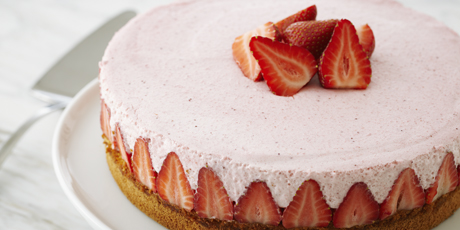
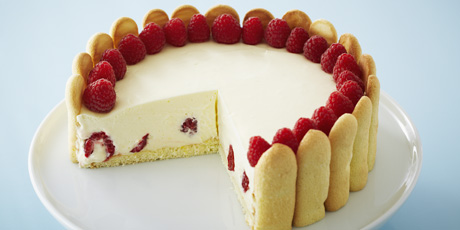
This torte, as it shall henceforth be labelled, is a combination of two Anna Olson recipes -
the Raspberry Lemon Torte:
and the Frasier Torte:
They are both so beautifully inviting, you just want to drop everything, get into the kitchen and start making them.
Right from the start, I decided against making the ladies fingers and base for the torte. Instead, I made a butter cake batter, baked in a 20 cm by 30 cm by 2 cm tray. This yielded a flat rectangular cake that would be cut into a square.
For the mousse, I added 1 tablespoon of gelatin powder to give a better set. This was a birthday torte after all, and would be sliced and served to guests. It needed a firmer set so it could hold its shape well, but without being rubbery.
Finally I decided to throw in some blueberries as well for a more aesthetic colour palette. Here is the torte:
All in all, it turned out pretty well, although there is scarcely any resemblance between this and the above torte. I did follow Anna Olson's lemon mousse recipe to a t, except for the addition of the gelatin. Yet the colour of the mousse was vastly different from hers. Mine was a sunshiny yellow which I rather prefer.
Now, if only I had the Anna Olson's professional photographer...
Tuesday, 26 November 2013
Monday, 9 January 2012
Cheese and Garlic Naan
There is something organic, visceral and immediate about eating with your hands, sans the cold metallic feel of cutlery. Other than the sight and smell of the food, another sense, that of touch, is kindled. Texture is explored even before the food reaches the mouth where taste and more textural qualities are experienced.
Bread lends itself perfectly to being held in your hands, torn and then popped into your mouth. It may be buttered or dipped into an unctous gravy. It can be wrapped around some scrumptious filling, even employed to wipe up every bit of sauce, eaten, and then the crumbs and any smidgen of sauce licked clean.
Naan is one of those breads that beckons you to hold it (never mind the heat) , tear it apart, dip it into a curry and quickly pop it into your mouth.
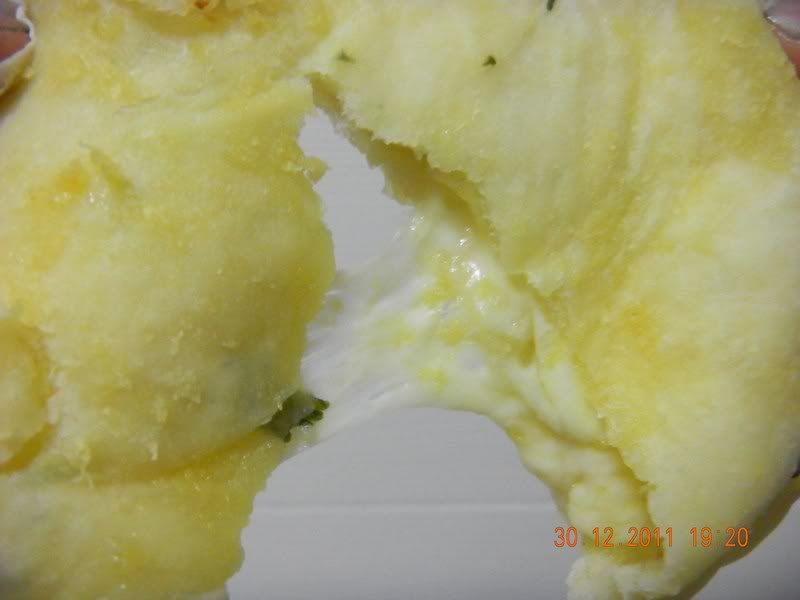
Even better is naan that is buttery and garlicky on the outside, and satiated with molten cheese within.
When I made the naan a couple of weeks ago, I had mistakenly assumed that a bag of bread flour was stashed in the fridge. It was plain flour I found instead. Yes, I just had to make do. The reduced gluten content of plain flour actually produced a softer, flufflier naan. Bread flour, with more protein or gluten, will coagulate to give a chewier bread. So just go with whatever rocks your boat.
Eat this naan with any kind of curry - dhal, vegetable or meat curries. It is especially indulgent with butter chicken - a north Indian curry that is mild, yet rich with butter and cream. Some tangy cucumber raita on the side wouldn't go amiss.
Ingredients:
3 and 1/2 cups bread or plain flour, plus extra for dusting
1 and 1/2 teaspoons salt
1 and 1/2 teaspoons sugar
1 and 1/2 teaspoons instant yeast
1/2 cup milk
2 eggs
1/4 cup yogurt
1 tablespoon oil
1 stalk coriander leaves
4 large cloves garlic, peeled and finely grated
1 tablespoon water
30 g salted butter
200 g grated mozarella
200 g grated cheddar
Method:
1. Mix the first 4 dry ingredients in a large mixing bowl.
2. Add the milk, eggs, yogurt and oil to the dry ingredients.
3. Using a spatula, gradually stir the flour into the liquids till all the flour is incorporated. Remember to scrape the sides well.
4. Flour your hands lightly and knead the dough for about 10 minutes till it becomes smooth and elastic. A small amount of additional flour may be needed if the dough is too sticky.
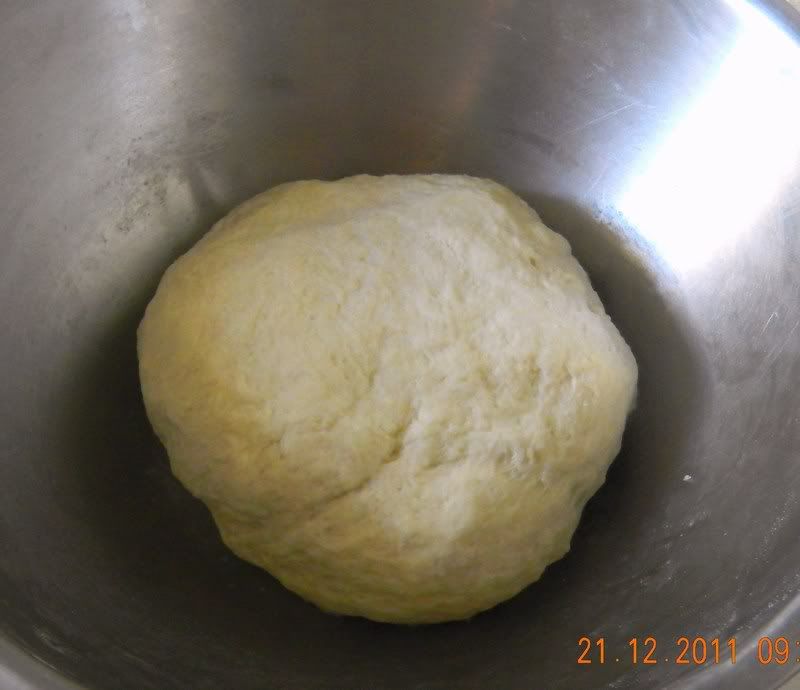
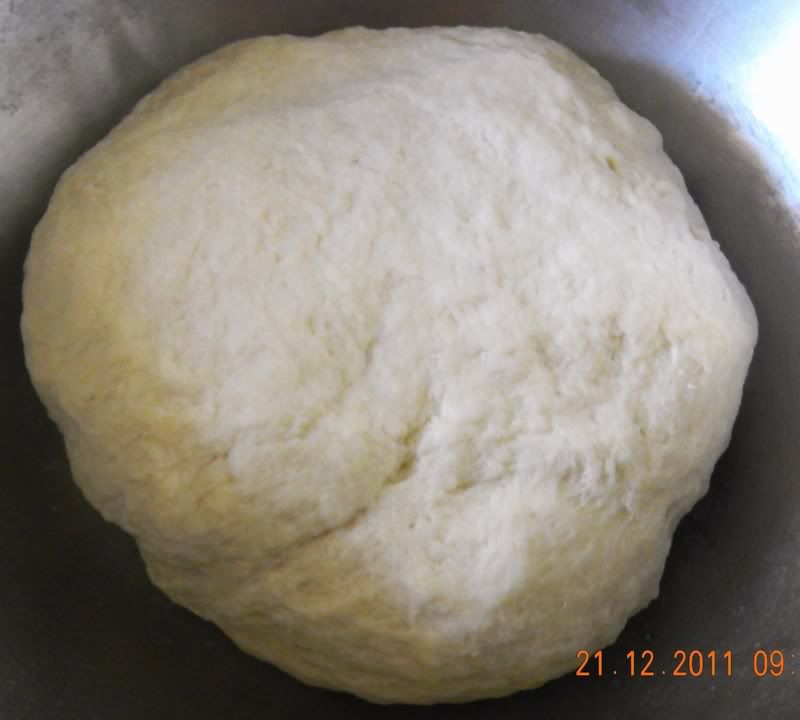
5. Form the kneaded dough into a disc. Place in the bowl and cover tightly with cling foil. Let the dough rise till it is about 3 times in volume.
6. In the meantime, remove the coriander leaves from the stems and roughly chop them.
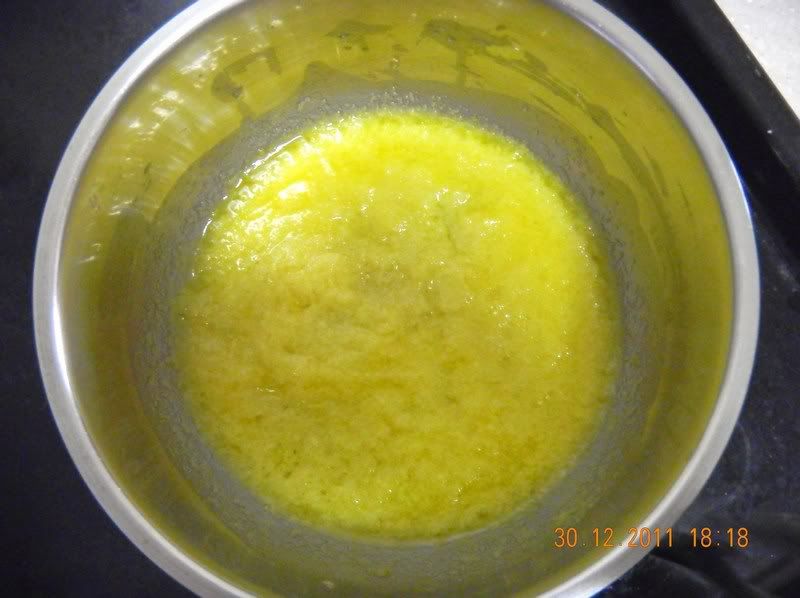
7. Cook the garlic and the tablespoon of water in a small pot using a low flame. It just needs a minute or two to reduce the pungency. Do not let the garlic brown. If it is drying up too fast, add a bit more water. Add the butter. Turn off the flame once the butter has melted.
8. Mix the 2 types of grated cheese together and divide them into 12 portions - either eyeball or use a scale. Press each portion of cheeses together to form a packed disc.
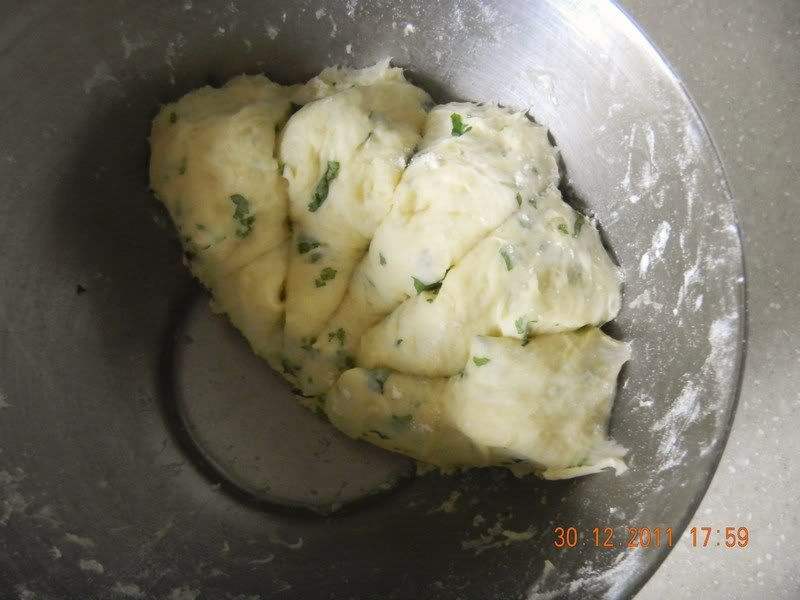
9. When the bread has adequately risen, remove it from the bowl and place on a lightly floured surface. Knead the coriander leaves into the dough till the leaves are well distributed. I find it easier to hold the dough in my hand, flatten and lightly stretch it into a rough rectangle slightly large than my palm. Leaving the dough on my palm, I'll sprinkle about a quarter of the coriander leaves onto the dough and then roll it up like a swiss roll. The rolled up dough will be flatten and stretched again into a rectangle, more coriander leaves are sprinkled on, and the dough rolled up. The process is repeated 2 more times till all coriander leaves are used up. This "swiss roll" method distributes the coriander leaves more uniformly. Of course all these can be done with the dough on the tabletop but then you'll have to clean said tabletop.
10. Leave the dough to rest in the bowl, covered, for about 15 minutes. This allows the gluten to relax, making the dough more malleable. Now divide the dough into 12 portions - again eyeball this or use the scale. Position a small dish of water, a bowl of extra flour and the cheese near to your worktop. You may wish to roll the naan on a clean chopping board like I do. Again easier cleaning up is my consideration.
11. Spread enough cling foil on your tabletop for the shaped naan. (Bread dough does not stick to cling foil the way it would to a naked tabletop).
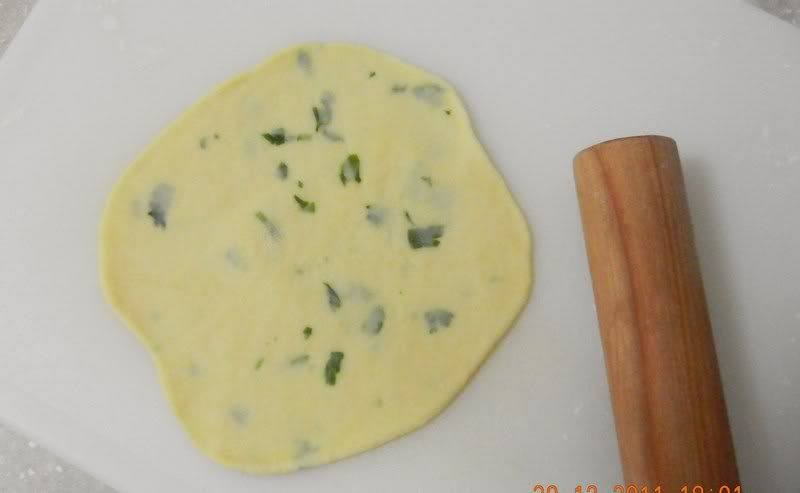
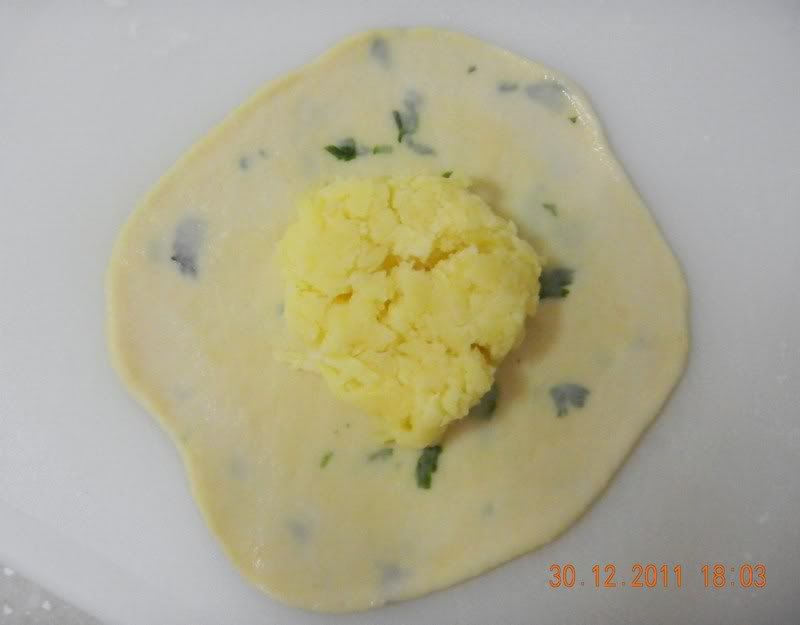
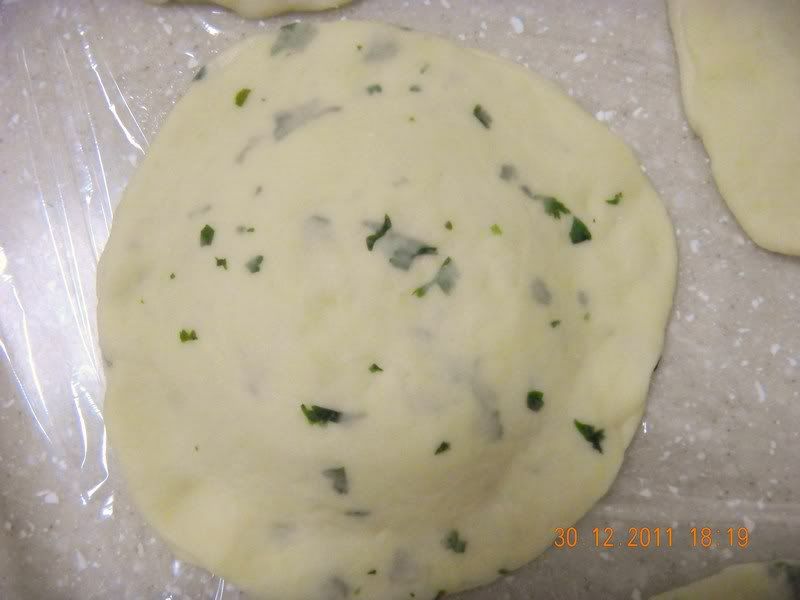
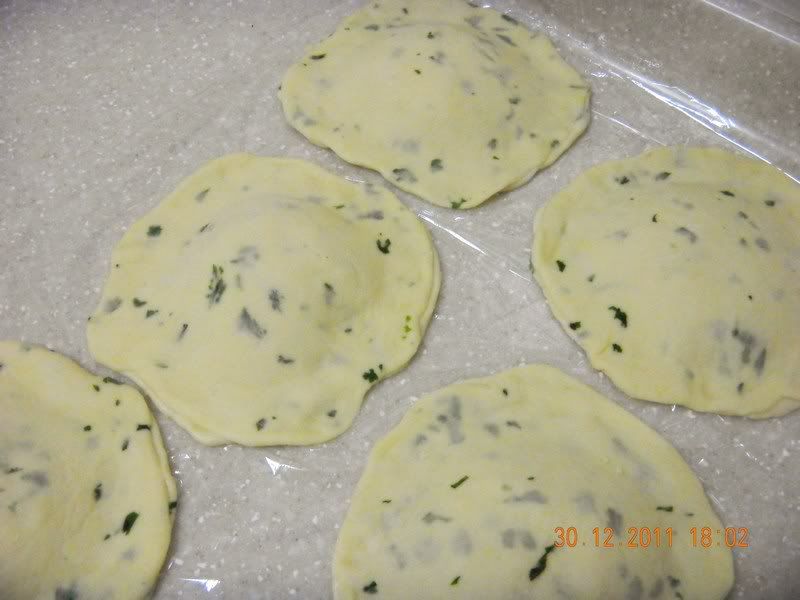
12. Pick up 1 portion of dough. Divide this into 2, roll them into balls and dust generously with flour. With a floured rolling pin, roll each ball into a circle about 18-20 cm in diameter. Place the cheese in the middle of 1 circle. Moisten the edges and cover with the other piece. Press the edges to seal tightly. Place the completed naan on the cling foil.
13. Repeat step 12 to make 12 pieces of naan. When you're on to the 10th piece, start the oven to 240 degrees Celsius with the baking tray in the oven to preheat as well. The naan will stick to a cold baking tray, making removal difficult and risking tears to the naan. I use the drip tray that comes with the oven.
14. Once the oven is ready, transfer the naan, piece by piece to the baking tray, spacing them about a cm or 2 apart. They will puff up, but not spread out. Fit in as many pieces as your tray can accomodate. I do 4 pieces at one go in mine.
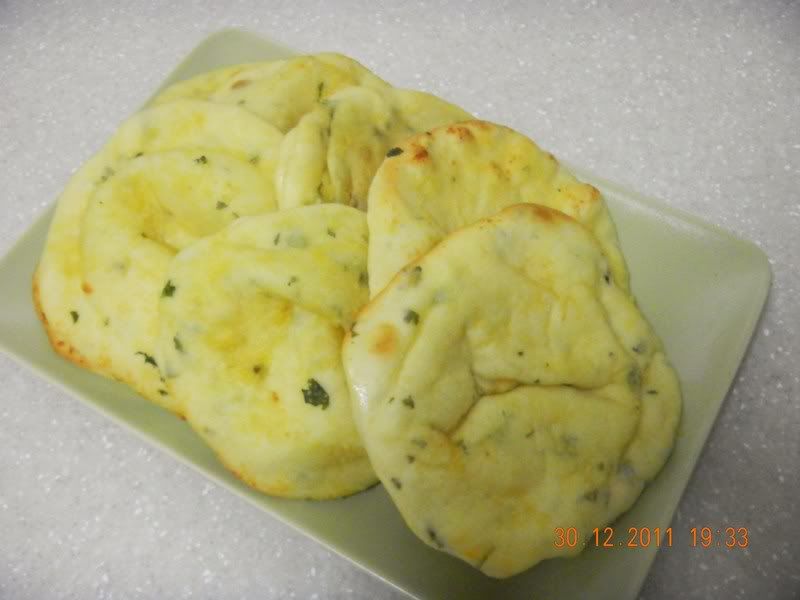
15. Bake for about 5 minutes. They will puff up dramatically and brown lightly in spots. Remove them from the oven with a frying slice and transfer to another tray. Load the baking tray with another batch of naan.
16. Brush the baked naan generously with the garlic-butter and place them in a basket or a serving platter. Cover loosely with a tea towel to keep warm.
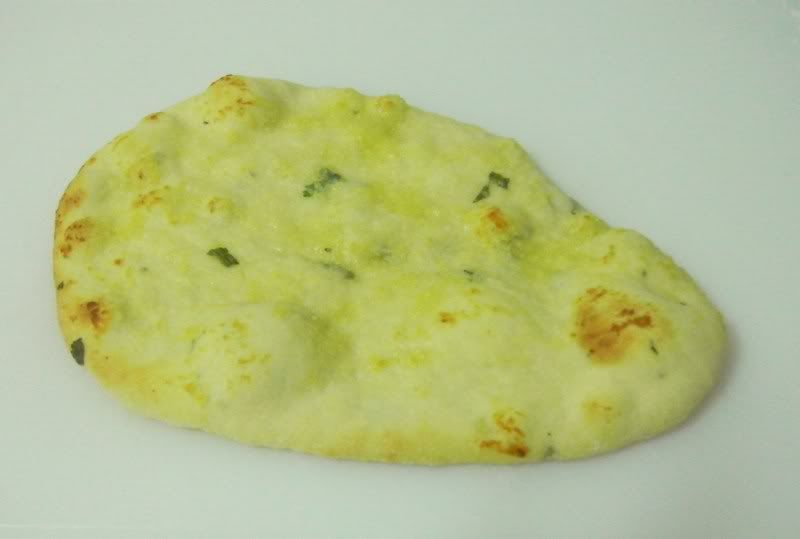
Instead of circular naan, you can make the more traditional pear-shaped ones like this:
Bread lends itself perfectly to being held in your hands, torn and then popped into your mouth. It may be buttered or dipped into an unctous gravy. It can be wrapped around some scrumptious filling, even employed to wipe up every bit of sauce, eaten, and then the crumbs and any smidgen of sauce licked clean.
Naan is one of those breads that beckons you to hold it (never mind the heat) , tear it apart, dip it into a curry and quickly pop it into your mouth.
Even better is naan that is buttery and garlicky on the outside, and satiated with molten cheese within.
When I made the naan a couple of weeks ago, I had mistakenly assumed that a bag of bread flour was stashed in the fridge. It was plain flour I found instead. Yes, I just had to make do. The reduced gluten content of plain flour actually produced a softer, flufflier naan. Bread flour, with more protein or gluten, will coagulate to give a chewier bread. So just go with whatever rocks your boat.
Eat this naan with any kind of curry - dhal, vegetable or meat curries. It is especially indulgent with butter chicken - a north Indian curry that is mild, yet rich with butter and cream. Some tangy cucumber raita on the side wouldn't go amiss.
Ingredients:
3 and 1/2 cups bread or plain flour, plus extra for dusting
1 and 1/2 teaspoons salt
1 and 1/2 teaspoons sugar
1 and 1/2 teaspoons instant yeast
1/2 cup milk
2 eggs
1/4 cup yogurt
1 tablespoon oil
1 stalk coriander leaves
4 large cloves garlic, peeled and finely grated
1 tablespoon water
30 g salted butter
200 g grated mozarella
200 g grated cheddar
Method:
1. Mix the first 4 dry ingredients in a large mixing bowl.
2. Add the milk, eggs, yogurt and oil to the dry ingredients.
3. Using a spatula, gradually stir the flour into the liquids till all the flour is incorporated. Remember to scrape the sides well.
4. Flour your hands lightly and knead the dough for about 10 minutes till it becomes smooth and elastic. A small amount of additional flour may be needed if the dough is too sticky.
5. Form the kneaded dough into a disc. Place in the bowl and cover tightly with cling foil. Let the dough rise till it is about 3 times in volume.
6. In the meantime, remove the coriander leaves from the stems and roughly chop them.
7. Cook the garlic and the tablespoon of water in a small pot using a low flame. It just needs a minute or two to reduce the pungency. Do not let the garlic brown. If it is drying up too fast, add a bit more water. Add the butter. Turn off the flame once the butter has melted.
8. Mix the 2 types of grated cheese together and divide them into 12 portions - either eyeball or use a scale. Press each portion of cheeses together to form a packed disc.
9. When the bread has adequately risen, remove it from the bowl and place on a lightly floured surface. Knead the coriander leaves into the dough till the leaves are well distributed. I find it easier to hold the dough in my hand, flatten and lightly stretch it into a rough rectangle slightly large than my palm. Leaving the dough on my palm, I'll sprinkle about a quarter of the coriander leaves onto the dough and then roll it up like a swiss roll. The rolled up dough will be flatten and stretched again into a rectangle, more coriander leaves are sprinkled on, and the dough rolled up. The process is repeated 2 more times till all coriander leaves are used up. This "swiss roll" method distributes the coriander leaves more uniformly. Of course all these can be done with the dough on the tabletop but then you'll have to clean said tabletop.
10. Leave the dough to rest in the bowl, covered, for about 15 minutes. This allows the gluten to relax, making the dough more malleable. Now divide the dough into 12 portions - again eyeball this or use the scale. Position a small dish of water, a bowl of extra flour and the cheese near to your worktop. You may wish to roll the naan on a clean chopping board like I do. Again easier cleaning up is my consideration.
11. Spread enough cling foil on your tabletop for the shaped naan. (Bread dough does not stick to cling foil the way it would to a naked tabletop).
12. Pick up 1 portion of dough. Divide this into 2, roll them into balls and dust generously with flour. With a floured rolling pin, roll each ball into a circle about 18-20 cm in diameter. Place the cheese in the middle of 1 circle. Moisten the edges and cover with the other piece. Press the edges to seal tightly. Place the completed naan on the cling foil.
14. Once the oven is ready, transfer the naan, piece by piece to the baking tray, spacing them about a cm or 2 apart. They will puff up, but not spread out. Fit in as many pieces as your tray can accomodate. I do 4 pieces at one go in mine.
15. Bake for about 5 minutes. They will puff up dramatically and brown lightly in spots. Remove them from the oven with a frying slice and transfer to another tray. Load the baking tray with another batch of naan.
16. Brush the baked naan generously with the garlic-butter and place them in a basket or a serving platter. Cover loosely with a tea towel to keep warm.
Instead of circular naan, you can make the more traditional pear-shaped ones like this:
Whatever the shape, check out the goodness within when you tear into that hot naan.
Tuesday, 27 December 2011
Post Christmas Casserole
It was the day after.
And a time of reckoning - what could be done about the Christmas leftovers?
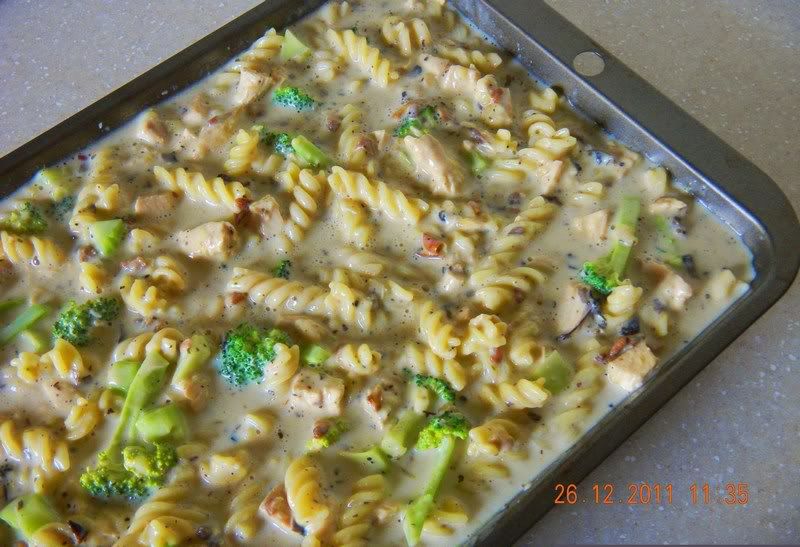
There were sufficient leftover roast chickens, mushroom stuffing and flavourful roast meat juices for a casserole. The other ingredients - dried pasta, milk and cheese are ubiquitous items in most kitchens. It might not be a bad idea to toss in some cubed ham, even the remnant salad vegetables like lettuce (remove any oxidized parts first), tomatoes and cucumbers. Since I hadn't any salad remaining, I threw in a head of broccoli, cut into half-floret pieces first.
I will not dictate specific amounts of ingredients for this casserole as different parties would surely yield differing amounts of leftover ingredients. Like cooking fried rice, just go with the feel. A rough guide would be an equal amount of dried pasta to leftovers to sauce - that is, 1 cup dried pasta to 1 cup leftover ingredients (packed) to 1 cup sauce. To estimate more accurately, cut up the ingredients first into cubes, slices ... whatever you fancy.
Cook the pasta in salted water first, but only up to about 70-80% done as the pasta will continue to absorb liquid as it bakes in the oven. Drain and tip into a large casserole/baking dish.
Make a simple cheese sauce following these ratios: 1 tablespoon butter (15 g) to 1 tablespoon flour to 1 cup milk to 2 slices cheese (I use the convenient package kind for sandwiches). Work out the total amount of sauce you'll need first, then go from there.
Melt the butter in a pot over a small flame. Add the flour and stir with a whisk till incorporated. Let the mixture cook for about half a minute then add the milk, whisking continously to break up any lumps of flour. Bring the sauce to a boil, stirring frequently. Once it boils, turn off the flame. You have just made a white sauce.
To turn this into a cheese sauce, simple include cheese. Okay, now add the slices of cheese to the sauce and allow the cheese to melt before stirring to obtain a smooth sauce. Season to taste with salt and pepper.
Stir the leftover ingredients into the sauce. Now pour everything into the pasta in the casserole dish. Mix them together. I think you should err on the side of more sauce here. Remember the pasta will absorb some of the sauce as it bakes. Just stir in more milk as you deem necessary and then taste - that means eat a small spoonful of the pasta together with the sauce. This affords a more precise assessment of the taste. Then add more salt and pepper as needed.
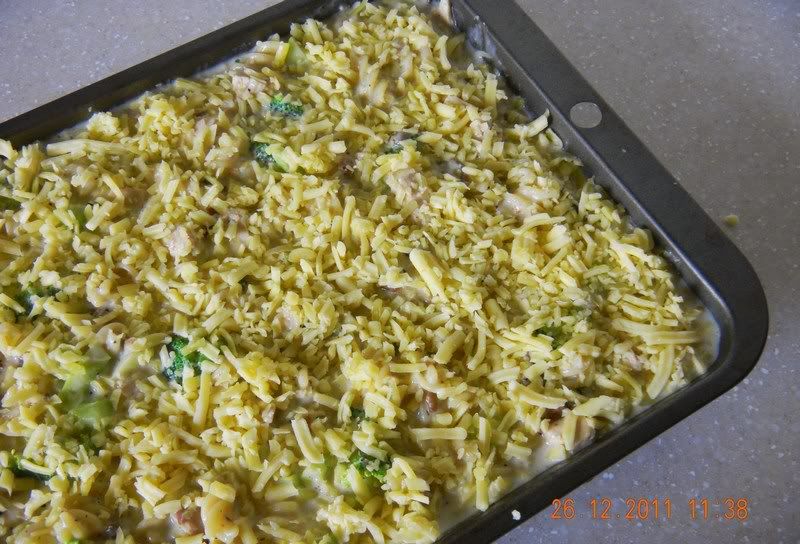
Sprinkle a generous layer of grated cheese. Alternatively, bread crumbs can also be added, or a combination of cheese and breadcrumbs.
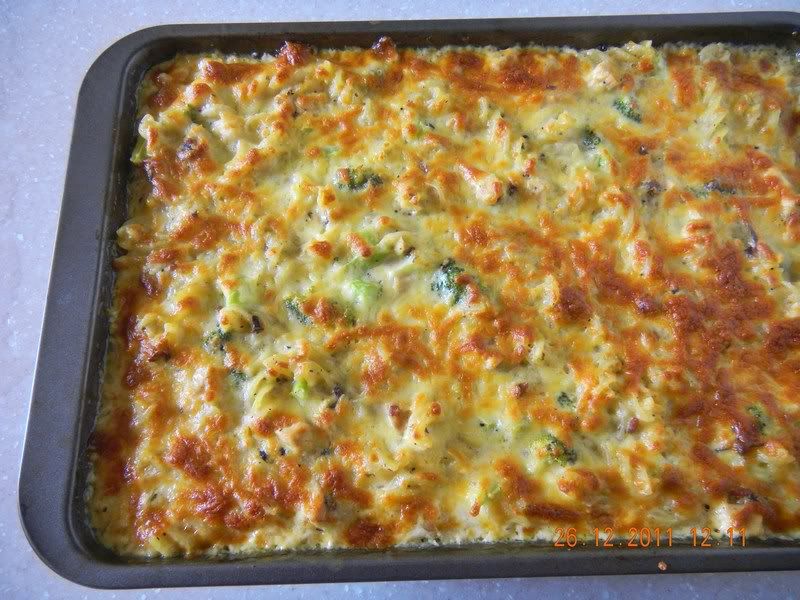
Bake at 200 degree Celsius (no need to preheat) for about 25 - 30 minutes till cheese is golden brown.
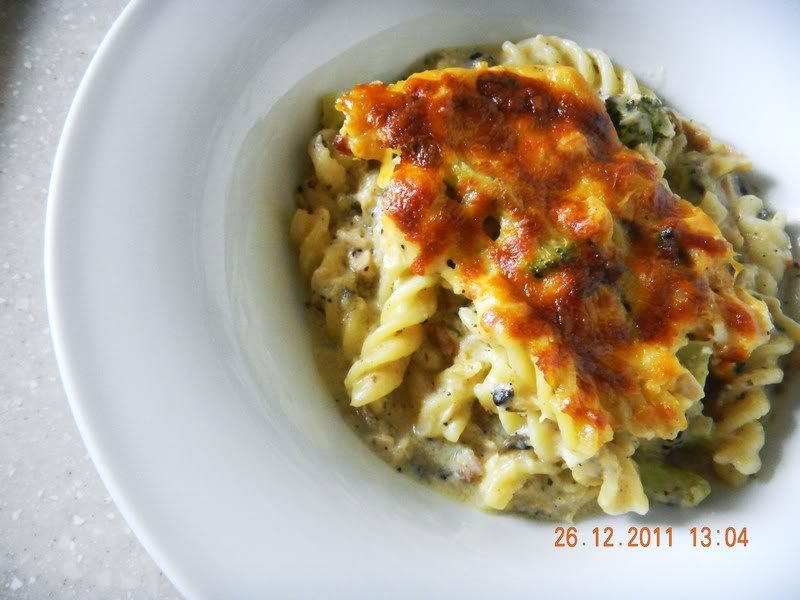
And that was my boxing day brunch.
And a time of reckoning - what could be done about the Christmas leftovers?
There were sufficient leftover roast chickens, mushroom stuffing and flavourful roast meat juices for a casserole. The other ingredients - dried pasta, milk and cheese are ubiquitous items in most kitchens. It might not be a bad idea to toss in some cubed ham, even the remnant salad vegetables like lettuce (remove any oxidized parts first), tomatoes and cucumbers. Since I hadn't any salad remaining, I threw in a head of broccoli, cut into half-floret pieces first.
I will not dictate specific amounts of ingredients for this casserole as different parties would surely yield differing amounts of leftover ingredients. Like cooking fried rice, just go with the feel. A rough guide would be an equal amount of dried pasta to leftovers to sauce - that is, 1 cup dried pasta to 1 cup leftover ingredients (packed) to 1 cup sauce. To estimate more accurately, cut up the ingredients first into cubes, slices ... whatever you fancy.
Cook the pasta in salted water first, but only up to about 70-80% done as the pasta will continue to absorb liquid as it bakes in the oven. Drain and tip into a large casserole/baking dish.
Make a simple cheese sauce following these ratios: 1 tablespoon butter (15 g) to 1 tablespoon flour to 1 cup milk to 2 slices cheese (I use the convenient package kind for sandwiches). Work out the total amount of sauce you'll need first, then go from there.
Melt the butter in a pot over a small flame. Add the flour and stir with a whisk till incorporated. Let the mixture cook for about half a minute then add the milk, whisking continously to break up any lumps of flour. Bring the sauce to a boil, stirring frequently. Once it boils, turn off the flame. You have just made a white sauce.
To turn this into a cheese sauce, simple include cheese. Okay, now add the slices of cheese to the sauce and allow the cheese to melt before stirring to obtain a smooth sauce. Season to taste with salt and pepper.
Stir the leftover ingredients into the sauce. Now pour everything into the pasta in the casserole dish. Mix them together. I think you should err on the side of more sauce here. Remember the pasta will absorb some of the sauce as it bakes. Just stir in more milk as you deem necessary and then taste - that means eat a small spoonful of the pasta together with the sauce. This affords a more precise assessment of the taste. Then add more salt and pepper as needed.
Sprinkle a generous layer of grated cheese. Alternatively, bread crumbs can also be added, or a combination of cheese and breadcrumbs.
Bake at 200 degree Celsius (no need to preheat) for about 25 - 30 minutes till cheese is golden brown.
And that was my boxing day brunch.
Wednesday, 21 December 2011
Shepherd's Staff Breadsticks
The Christmas dinner - I love and dread it, but for now haven't the time to muse, rant or pontificate about it, as obviously, I am in the process of cooking this meal.
Very quickly, on the menu this year are:
- Clam chowder with shepherd's staff breadsticks
- Pommes dauphinoise (potatoes baked in cream, but sounds
fancier in French)
- Pasta in tomato and cheese sauce
- Roast Chicken (with herbs) and portabella and bacon stuffing
- A simple salad
- Chocolate and salted caramel brownie ice cream
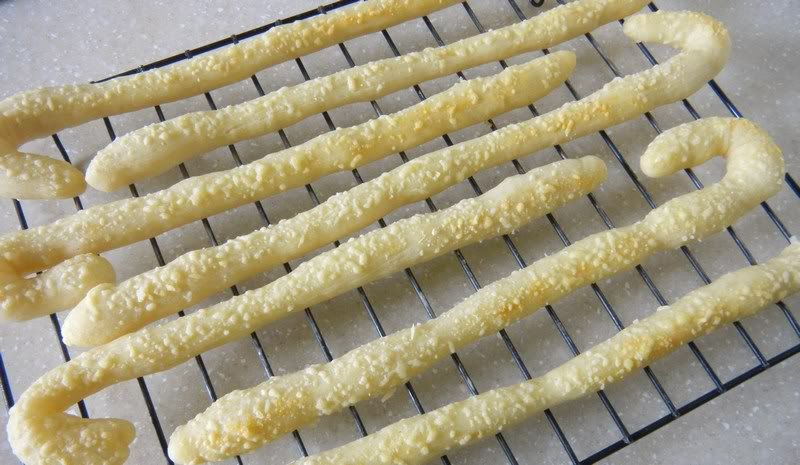
Since I have not posted any recipe, here is the first one - for the Shepherd's Staff Breadsticks.
Ingredients for dough:
3 cups bread flour
1 teaspoon salt
1 teaspoon sugar
1 teaspoon yeast
1 cup + 1 tablespoon water
1 tablespoon oil
extra flour for kneading and rolling
Ingredients for topping:
2 tablespoons olive oil or melted butter
1/2 cup of grated parmiggiano reggiano or mature cheddar
Method:
1. Mix the flour, salt, sugar and yeast in a large mixing bowl. Make a well in the centre and add the water and oil.
2. Using a spatula, draw the flour into the liquid till incorporated. Scrap the sides of the bowl well.
3. Flour your hands lightly. Sprinkle a bit of flour over the dough and knead till all the flour is mixed in. Add a bit more flour (about 1/2 tablespoon) only if bits of the dough still stick to your hand and continue to need till the added flour is mixed in. Repeat if dough still sticks to your hands.
4. Knead for a total of about 10 minutes. The dough will become smooth and elastic as you knead. It will feel moist but it should not stick to your hands.
5. Shape the dough into a disc. Leave it in the mixing bowl and cover the bowl tightly with cling foil. Leave the dough to rise till tripled in volume. It may take 2 to 4 hours. (Mine took about 3 and a half.)
6. Line two or three 38 x 25 cm trays with non-stick baking paper. (Or just use the largest trays that fits your oven. Oven and tray sizes will determine the lengths of the staffs.)
7. Put the parmiggiano reggiano on a plate.
8. When the dough is risen, divide it (use a pair of floured scissors) into 24 pieces. I do this by cutting the round dough into quarters, roll each quarter into a sausage and then cut it into 6 portions. (Just eyeball it as best as you can. It does not matter if shepherd's staffs are of differing lengths - more interesting actually.)
9. Flour one portion of dough and roll it on a clean work top (a rectangular chopping board is good) to as long as the length of your tray. You will find that the dough will stubbornly resist your attempt to lengthen it fully and will keep shrinking. Just do the best you can and then leave the dough strip on the prepared tray and get on with the next piece. As you work your way through the whole batch, the gluten in the dough strips you have rolled out will relax and be ready for you to stretch them again.
10. Now go back to the first strip of dough. This time, do not roll it but pick it up gently and stretch it the desired length. Lay it on the tray and remember to curve one end of the dough so it resembles a staff. Repeat with the rest of the dough strips. (Remember: if the dough is being stubborn again, leave it alone and get on with the rest first. Kinda of like how you would handle a stiff-necked kid throwing a hissy fit.)
11. Preheat the oven to 240 degrees Celsius or 220 degrees Celsius in a fan-assisted oven.
12. Working on one staff at a time, smear each staff with oil/butter. (I simply do this with my fingers - washing an oily brush is no fun.)
13. Gently pick up oiled/buttered stuff and dredge the oiled/buttered part in the grated cheese. Return to tray. Repeat for all the rest of the staffs.
14. If you are preparing this way in advance for a meal, bake each tray for 5 - 6 minutes till just lightly golden. Remove from the oven and cool completely on a rack.* This baking time will merely cook the dough. Just before eating, preheat the oven to the same temperature and bake the breadsticks (cold from the fridge) for a further 10 - 15 minutes till golden brown and crispy.
15. If you're going to eat the breadsticks right away, bake them for about 10 - 15 minutes.
16. Serve these breadsticks in a glass tall glass container/jar.
Hmm...these do look like candy cane breadsticks too. I will post more pictures of the fully baked shepherd's staffs after Christmas.
* To store the partially baked breadsticks, wrap them tightly in aluminium foil and keep in the fridge.
In the frenzy to get the Christmas dinner ready, I had forgotten to take pictures of the tanned breadsticks standing tall in the glass jars. The pics will have to wait till another batch is baked - no telling as to when that will occur. Thousand apologies.
Very quickly, on the menu this year are:
- Clam chowder with shepherd's staff breadsticks
- Pommes dauphinoise (potatoes baked in cream, but sounds
fancier in French)
- Pasta in tomato and cheese sauce
- Roast Chicken (with herbs) and portabella and bacon stuffing
- A simple salad
- Chocolate and salted caramel brownie ice cream
Since I have not posted any recipe, here is the first one - for the Shepherd's Staff Breadsticks.
Ingredients for dough:
3 cups bread flour
1 teaspoon salt
1 teaspoon sugar
1 teaspoon yeast
1 cup + 1 tablespoon water
1 tablespoon oil
extra flour for kneading and rolling
Ingredients for topping:
2 tablespoons olive oil or melted butter
1/2 cup of grated parmiggiano reggiano or mature cheddar
Method:
1. Mix the flour, salt, sugar and yeast in a large mixing bowl. Make a well in the centre and add the water and oil.
2. Using a spatula, draw the flour into the liquid till incorporated. Scrap the sides of the bowl well.
3. Flour your hands lightly. Sprinkle a bit of flour over the dough and knead till all the flour is mixed in. Add a bit more flour (about 1/2 tablespoon) only if bits of the dough still stick to your hand and continue to need till the added flour is mixed in. Repeat if dough still sticks to your hands.
4. Knead for a total of about 10 minutes. The dough will become smooth and elastic as you knead. It will feel moist but it should not stick to your hands.
5. Shape the dough into a disc. Leave it in the mixing bowl and cover the bowl tightly with cling foil. Leave the dough to rise till tripled in volume. It may take 2 to 4 hours. (Mine took about 3 and a half.)
7. Put the parmiggiano reggiano on a plate.
8. When the dough is risen, divide it (use a pair of floured scissors) into 24 pieces. I do this by cutting the round dough into quarters, roll each quarter into a sausage and then cut it into 6 portions. (Just eyeball it as best as you can. It does not matter if shepherd's staffs are of differing lengths - more interesting actually.)
9. Flour one portion of dough and roll it on a clean work top (a rectangular chopping board is good) to as long as the length of your tray. You will find that the dough will stubbornly resist your attempt to lengthen it fully and will keep shrinking. Just do the best you can and then leave the dough strip on the prepared tray and get on with the next piece. As you work your way through the whole batch, the gluten in the dough strips you have rolled out will relax and be ready for you to stretch them again.
10. Now go back to the first strip of dough. This time, do not roll it but pick it up gently and stretch it the desired length. Lay it on the tray and remember to curve one end of the dough so it resembles a staff. Repeat with the rest of the dough strips. (Remember: if the dough is being stubborn again, leave it alone and get on with the rest first. Kinda of like how you would handle a stiff-necked kid throwing a hissy fit.)
11. Preheat the oven to 240 degrees Celsius or 220 degrees Celsius in a fan-assisted oven.
12. Working on one staff at a time, smear each staff with oil/butter. (I simply do this with my fingers - washing an oily brush is no fun.)
13. Gently pick up oiled/buttered stuff and dredge the oiled/buttered part in the grated cheese. Return to tray. Repeat for all the rest of the staffs.
14. If you are preparing this way in advance for a meal, bake each tray for 5 - 6 minutes till just lightly golden. Remove from the oven and cool completely on a rack.* This baking time will merely cook the dough. Just before eating, preheat the oven to the same temperature and bake the breadsticks (cold from the fridge) for a further 10 - 15 minutes till golden brown and crispy.
15. If you're going to eat the breadsticks right away, bake them for about 10 - 15 minutes.
16. Serve these breadsticks in a glass tall glass container/jar.
Hmm...these do look like candy cane breadsticks too. I will post more pictures of the fully baked shepherd's staffs after Christmas.
* To store the partially baked breadsticks, wrap them tightly in aluminium foil and keep in the fridge.
In the frenzy to get the Christmas dinner ready, I had forgotten to take pictures of the tanned breadsticks standing tall in the glass jars. The pics will have to wait till another batch is baked - no telling as to when that will occur. Thousand apologies.
Ginger Flower Ice Cream
Ice cream making is new to me but it is intriguing and seems simple enough to attempt without parting with cash for an ice cream maker. Anyway I am not one for purchasing a gadget that serves only one function, will undoubtedly wear out its novelty and thereafter, simply occupies prime real estate in my burst-at-the-hinge cabinet.
As mentioned in my previous post, the ginger flower ice cream I made was more like a sorbet. I need to correct that. The sorbet (store-bought) I have tasted are actually quite smooth. There were large crunchy ice crystals in my ice cream although I did the manual whisking of the ice cream mixture a few times more that the 3 recommended in most recipes. Yeah I know - super kiasu.
In an ice cream maker, the ice cream mixture is constantly churned as it freezes. This churning prevents the formation of large ice crystals, and hence enables the ice cream to become smooth and creamy.
Without an ice cream maker, once the ice cream mixture starts to freeze around the sides of the container, the mixture will have to be whisked to break up the ice crystals. This step must be repeated about 3 times. Another way to ensure creaminess and reduce the amount of ice crystal formation is to increase the amount of cream and cut down on the water content in the recipe. I did this simply by using 2 cups of coconut milk instead of 1 cup coconut milk and 1 cup whole milk. 100 ml of coconut milk has about 20 g or more of fat compared to whole milk's 3.5 - 4.1 g.
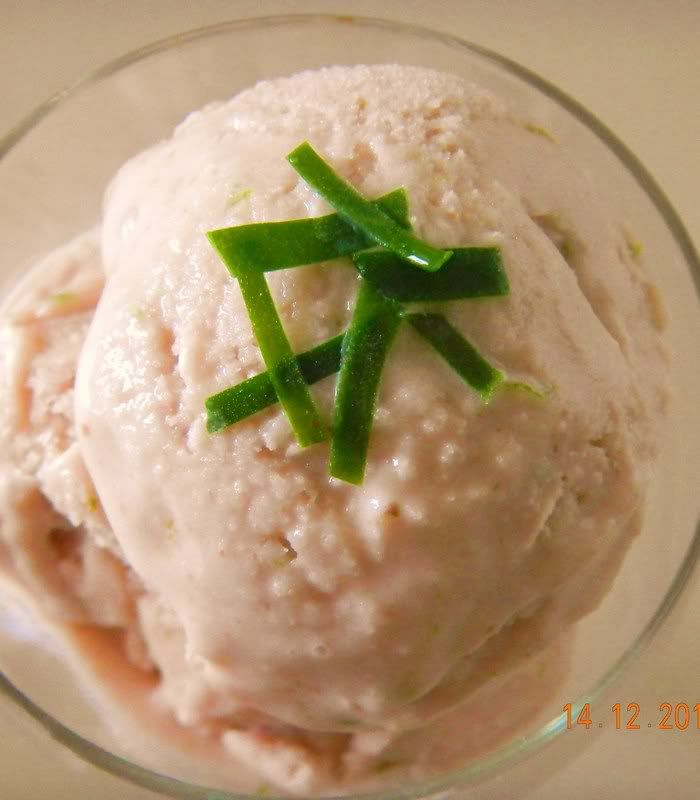
The other problem that needed fixing was the next to non-existent kaffir lime flavour. Previously, I used kaffir lime leaves which were pureed together with the ginger flower. Now I opted for the finely grated rind of 2 kaffir limes and used the kaffir lime leaf as a garnish instead. Problem solved.
I also increased the amount of food colouring for a pink hue reminiscent of a ginger flower. It takes no more than a couple more toothpicks (tips only) dipped into the food colouring and then into the ice cream mixture.
This time the ice cream was creamy without the grainy ice crystals. The ethereal flavour of the ginger flower hits you first, followed by the nuanced notes of the kaffir lime, with the coconut tying all these flavours together.
Someone tasting this ice cream the first time would be hard put to nail the flavour. My sister-in-law's initial reaction was, "Mmm... is it hae bee hiahm?" Then when told that it was the rojak flower, she went "Oooh!" and ate it all up.
I am completely satisfied with the outcome of this ice cream which is given the thumbs up by all the ginger flower lovers in my family. For the few who can't wrap their minds around this new Asian ce cream flavour, I can only say that it's their loss.
Tuesday, 29 November 2011
Magical Ginger Flowers
My first encounter with ginger flowers occurred when I was just a little kid. I can't recall the exact time or place. I just knew that that particular dish of rojak I was eating tasted different, in a really wonderful though inexplicable way. I didn't then, nor now, have the vocabulary to describe this new taste sensation, except to note that I had never tasted rojak like this before.
Most Singaporeans encounter ginger flowers when they eat rojak. Even then, not all rojak sellers include this ingredient, so there may be some poor souls who are deprived of this exquisite taste. Other than rojak, ginger flowers are used only in certain recipes found in Nonya and Malay cuisines - like Penang Laksa and Nasi Ulam.
How does one describe the taste of ginger flowers? Tasted on its own, the petals give off only slight flowery accents that end on a somewhat sour note. But when included in a recipe, they transform into a lilting floral and gentle perfume - not cloying the way an overdose of rose flavour can be. Other than that, it is a flavour that is difficult to grasp in a tangible way. To me the taste of ginger flowers is ethereal, up-lifting and simply magical.
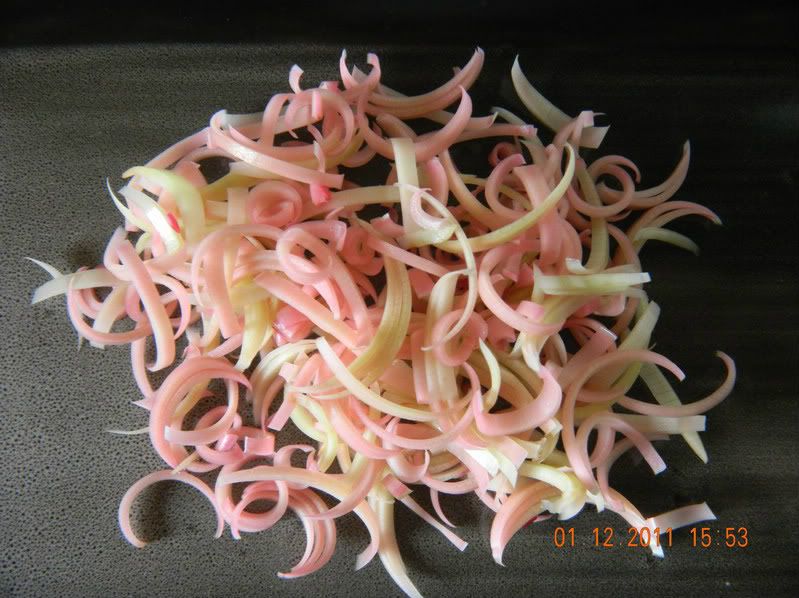
Since ginger flowers are an uncharacteristic ingredient in the repertoire of daily meals, they are hence not commonly found in supermarkets. You have a better chance of finding them in wet markets where they are usually sold by one of the vegetables stalls. Tekka market is the one place where ginger flowers are seen in abundance. By that I mean that about 3 or 4 of the vegetable stalls offer this item - a whole bunch of the flower buds in their unmistakable shade of pink with light green slender stalks. When you come across these flower buds, buy a few as they freeze very well. They can be frozen whole if you plan to use an entire bud in a recipe. Or detach the petals and divide them among several bags for easier access if only a small amount is required at a time.
I am doing a series of Asian herbs recipes, with particular interest in using some of these herbs in desserts. Curiously this gentle flower bud seems to dominate the recipes I am attempting to create, so much so that I have decided to do a category of recipes featuring it as the star. The ginger flower lends itself well to both sweet and savoury cooking. I have used ginger flowers in making crumble and muffins for the book The Asian Oven.
Yesterday, I made ginger flower-kaffir lime-coconut ice cream. The texture was disappointing - the ice cream turned out more like a sorbet. However the floral and coconutty flavours were distinct yet not overwhelming, and complement each other charmingly. But the lime was not detected at all. Some serious tweaking is in order.
You will read of the outcome once I taste success!
Monday, 28 November 2011
Anthony Bourdain and Chicken Rice
For many years, I have resisted the bidding of friends and family to start a blog. Finally, out of sheer perversity, I have done it. If nothing else, it is also to demystify the process of creating one. Maintaining a blog would be a work in progress for me - there are too many things to learn at one go.
Alright, now to posting proper.
In his book, The Nasty Bits, Anthony Bourdain described chicken rice, one of Singapore's iconic dishes, as:
"...basically, boiled chicken and white rice."
My jaw dropped in horror and utter incomprehension at those words. Would you describe a hamburger as cooked meat and bread? Or our beloved rojak as pieces of vegetables in a brown sauce?
Before you decide to hurl a bunch of chicken bones at his head, Mr Bourdain did offer more descriptive details a couple of paragraphs later, after he had sampled the dish at Tian Tian Hainanese Chicken Rice:
"...a heap of soft, pillowy white rice with pale, juicy chunks of chicken piled in the
center. A little cucumber, some supersticky spicy hoisin-style sauce, a little
grated ginger, and a garlic pepper sauce are served on the side. You mix it all
together to fit personal preferences....I watched locals eagerly drizzling, dipping,
and mixing the basic elements into personalized concoctions..."
Mr Bourdain nailed the "personalized concoction" part. I like chicken rice au naturel. My sons prefer a generous drizzle of the thick dark sauce while my husband will mix in a healthy amount of grated ginger sauce.
I would extend "personal preferences" to include not just the sauces, but also a particular cut of the chicken. Most chicken rice connoisseurs prefer the thigh, drumstick or wing. And then there is the choice of white or roast chicken.
"A little cucumber"? He got that down pat too.
Now let's come to the rice. Calling this essential component of the dish "white rice" is wrong on so many levels. If Mr Bourdain had looked at his plate of chicken rice, he would have noticed that the rice is not white but an off-white or ivory colour, each grain coated with a thin layer of oil. White rice is what you get when rice grains are cooked in plain water. That ivory tint of chicken rice is a result of cooking rice grains in chicken broth with the inclusion of salt, ginger, garlic, pandan leaves, chicken fat (or vegetable oil) and sometimes, lemongrass. Some hawkers may even fry these ingredients in the chicken fat or oil before adding to the broth and rice. Cooked thus, the rice is infused with all the aromatic flavours, so good you can eat it on its own.
What about "boiled" chicken? Boiled chicken would taste only marginally juicier compared to jerky. Those "juicy chunks" of chicken are possible only when the chicken is not boiled. The white chicken that accompanies chicken rice is not steamed either. Instead a whole chicken is submerged in water that is brought to the boil only to have the heat turned off. The chicken is then left to slowly cook in the residual heat for about half an hour. The entire process is repeated 2 or 3 times, depending on the size of the chicken. This gentle method of cooking that veers towards poaching rather than boiling, ensures that the chicken is just cooked and retains most of its juices.
When Mr Bourdain next comes visiting, his local food guide, Mr Seetoh of Makansutra should serve him a dish of boiled chicken and white rice side by side with the real McCoy. Surely Mr Bourdain would then be able to discern the difference even as he customizes the dish to suit his preference?
Alright, now to posting proper.
In his book, The Nasty Bits, Anthony Bourdain described chicken rice, one of Singapore's iconic dishes, as:
"...basically, boiled chicken and white rice."
My jaw dropped in horror and utter incomprehension at those words. Would you describe a hamburger as cooked meat and bread? Or our beloved rojak as pieces of vegetables in a brown sauce?
Before you decide to hurl a bunch of chicken bones at his head, Mr Bourdain did offer more descriptive details a couple of paragraphs later, after he had sampled the dish at Tian Tian Hainanese Chicken Rice:
"...a heap of soft, pillowy white rice with pale, juicy chunks of chicken piled in the
center. A little cucumber, some supersticky spicy hoisin-style sauce, a little
grated ginger, and a garlic pepper sauce are served on the side. You mix it all
together to fit personal preferences....I watched locals eagerly drizzling, dipping,
and mixing the basic elements into personalized concoctions..."
Mr Bourdain nailed the "personalized concoction" part. I like chicken rice au naturel. My sons prefer a generous drizzle of the thick dark sauce while my husband will mix in a healthy amount of grated ginger sauce.
I would extend "personal preferences" to include not just the sauces, but also a particular cut of the chicken. Most chicken rice connoisseurs prefer the thigh, drumstick or wing. And then there is the choice of white or roast chicken.
"A little cucumber"? He got that down pat too.
What about "boiled" chicken? Boiled chicken would taste only marginally juicier compared to jerky. Those "juicy chunks" of chicken are possible only when the chicken is not boiled. The white chicken that accompanies chicken rice is not steamed either. Instead a whole chicken is submerged in water that is brought to the boil only to have the heat turned off. The chicken is then left to slowly cook in the residual heat for about half an hour. The entire process is repeated 2 or 3 times, depending on the size of the chicken. This gentle method of cooking that veers towards poaching rather than boiling, ensures that the chicken is just cooked and retains most of its juices.
When Mr Bourdain next comes visiting, his local food guide, Mr Seetoh of Makansutra should serve him a dish of boiled chicken and white rice side by side with the real McCoy. Surely Mr Bourdain would then be able to discern the difference even as he customizes the dish to suit his preference?
Subscribe to:
Comments (Atom)